
Leadville 100 Race Report
The starting line of Leadville was hectic and more chaotic than I’d expected, as I stood in a field of 700+ runners. There was also the question of where to line up. Although the first few miles of the Leadville course are downhill, flat and on wide dirt roads, I didn’t want to get stuck in a conga line of runners along the Turquoise Lake section. Because of that, I had debated how I would start this race for months and had a general plan, but the question of where to line up still bugged me. I knew there would be many first time 100 milers at this event who would start too quickly on the flats and then slow down once the race reached the technical trail by Turquoise Lake. In most races, I would not care, but after waiting 6 years to get into Leadville, I did not want to get stuck behind someone because of inexperience.
There was a lot of commotion at the start. It was packed. In front of me was Andy Glaze, who it was great to exchange greetings with for the fourth time at a race. It’s funny because we’ve still never shared any real miles together on a course despite so many short interactions. At the start line, there was also my friend Joel, who had big ambitions for his third LT100, including a potential podium spot. There was also an acquaintance, Luke from my local run club, and David Roche, who slid into the starting corral at the last second. I questioned starting only a person or two back from the starting line, but I knew someone like Andy wasn’t going to be winning, so why couldn’t I line up that far up front? Besides, I had big ambitions for myself at this event too.
When the gun went off, I was dazzled for a moment. First, my ears began to ring, the result of the shotgun that goes off to signal the start of the Leadville 100. All around me, tens of front-runners sprinted off the line at a blistering sub-7 pace; way too fast for all of them to maintain. I let them go, opting to be the fox instead of the rabbit. In the meantime, I accidentally clicked start on my watch twice, and paused it, therefore not accurately recording the first quarter mile. Frustrating.
Despite what felt like a good job taming my excitement and adrenaline, I still started pretty fast on my own. The first four miles I clocked were a 7:32, 7:58, 8:13 and 8:32 as I slowly eased into a steady pace of 9-10 minute miles. It did help that the first three miles of the race were downhill, after which the course flattened out. By the time I reached the four-mile marker, the buzz surrounding the starting line was surprisingly starting to dissipate. I thought this would take longer given the size of the field. Ahead of me were about 70 runners who all seemed to think they needed to start at David Roche’s pace. And then, there was me, in no-man’s land. There were a few runners around me, but not nearly what I had anticipated the beginning of Leadville being like. By the time I reached the Turquoise Lake singletrack, I was basically on my own, logging steady 9-10 minute miles. My pre-race pacing plan was going perfectly, and it seemed like I had started out fast enough to avoid a dreaded mile 5 conga line, but slow enough to reserve my energy for later in the race. I knew this because soon, a few runners would catch up with me, and we would spend the entire section from miles 4-10 around Turquoise Lake chatting with them; a sign my pace was adequate. Shortly after reaching the Turquoise Lake singletrack, a flashlight appeared behind me. The runner did not want to pass, but was open to chatting. He introduced himself as Matt and despite the fact that we could not see each other’s faces running in a conga line formation, it turns out we had shared miles together in the winter of 2024 at Stories Ultra in Colorado Springs. How small the ultrarunning world can be sometimes; even in a field of 700+ runners. It was fun catching up with an old acquaintance, and the conversation helped the pace stay humble early on in a 100 mile event.
Aside from conversing with other runners, most of my miles around Turquoise Lake were largely uneventful. Because the Leadville 100 starts at 4:00am, my view of the lake was nonexistent for the majority of the section. Instead, my gaze was fixed upon foot placement, and my mind was focused on fueling properly to start the race as well.
It is a good thing my gaze was focused on foot placement because about a mile before nearing the end of the lake, as the sun was rising and daylight was taking hold, I passed a man who I had briefly conversed with during my run around the lake. He was from New Zealand and while conversing, he seemed excited to be at Leadville. However, this time when we spoke, something seemed wrong. He was very concerned and told me he had rolled his ankle. Just as important, I thought, was the tone of his voice. He sounded alarmed and his speech felt rushed; I wondered if he was potentially in a state of shock. In that moment, my intuition kicked in. I told him to first and foremost, not take his shoe off. This is because if you take your shoe off after spraining or breaking an ankle, the affected area balloons with inflammation; often making it impossible to fit a shoe back onto the affected foot. Second, I told him to remain calm. We were only a mile or two from the first aid station, where a real medic could surely help him. I also reminded him that 100 milers are long. When we make a big mistake like rolling an ankle or taking a wrong turn, it is natural for our adrenaline to kick in. When that happens, we often attempt to compensate for the mistake. While this is a natural response, it often leads to people trying to correct an error in haste, which expends a lot of energy and often furthers the burden of our original mistake. For example, many people will experience a burst of adrenaline that motivates them to sprint back on course after making a wrong turn, which only worsens our condition. We do not think clearly when trying to solve problems at our maximum stress level. I told this runner to take some deep breaths, remember that his pain would likely be temporary, and that in a few short miles, he would be back to normal. Whether this was true or not was irrelevant. I don’t know if he wanted my advice in retrospect, but this is what we must do when we make mistakes. Remain calm, take deep breaths, and make rational, thoughtful decisions. In ultras and in life, mistakes happen, and usually those mistakes only lead to temporary problems.
Shortly after this incident, I reached the concrete road that would take me into the Mayqueen aid station. I got there in 1:58, which was 3 minutes off my predicted arrival time. I was happy with this. What I was not happy about was that I accidentally lost half of the electrolytes in the Tailwind packet I was trying to open while jogging into the aid station. In my mind, I was saving time opening the packet while running, but in reality, walking for 30 seconds would have helped my nutrition plan stay on track. On the bright side, I only spent about two minutes at the aid station, where I refilled my bottles with water (and half my electrolyte packet), grabbed some chips and m&m’s. I also threw my headlamp into my waistbelt (since I had started the race with a waistbelt and handheld bottle; no pack).
After leaving Mayqueen, the Leadville 100 course runs up a short concrete embankment towards the Colorado Trail. This section of trail is short, only 2-3 miles long but is very technical and rocky. Reaching this section of trail brought many memories to mind. Particularly, my time hiking 300 miles of the Colorado Trail in 2022. Only a few short years ago, I had pitched a tent along this section, downed shots of whiskey with a fellow thru-hiker and spent the night stressing about whether a bear would steal my food or not. Back then, my trail name was Rich Sloth, an ode to the Boa branded shorts I was hiking in (and actually ran LT100 in too). I found the name funny because of its irony. In 2022, I was a broke grad school student studying to attain my Master’s degree in Nutrition. I was also fast, and averaged 25 miles per day of hiking for two full weeks until my time on trail was cut short due to injury at the 300 mile mark. One day, I will return to the Colorado Trail (which is 485 miles in its entirety) to finish it, but it will be on my own terms. Not a project that I rush.
It was cool to finally be running this stretch of trail during the Leadville 100 and reminisce about those times, which seem so long ago. Even back then while hiking, I remember thinking this section of trail was very rocky. I tried my best to take the section slowly and run what I could. On top of technicality, this section trends uphill, and I knew I would be able to run more once the trail popped out onto the road that traverses Sugarloaf Pass. I will be the first person to tell you that I am a good hiker, but not a great one. With that said, I have a lot of raw speed and excel on 300-500 foot per mile gradients. That is my strong suit when racing ultras.
When the Colorado Trail finally spat me out onto the road, I was excited to begin taking advantage of my strengths as a runner. However, I found the run over Sugarloaf Pass to be surprisingly harder than I expected. It actually had nothing to do with the course, but with my stomach which felt bloated. The sensation was frustrating because I was only at mile 16. Usually, GI distress during an ultra doesn’t begin until much later (or when the temperature is much hotter). However, with experience of running 13 prior 100 milers under my belt, I was able to associate the feeling with how I felt at mile 38 of Western States. At WSER, I had a very similar feeling in my stomach, which passed after a few miles when I passed gas. Because of that, my best guess was my bloating was related to gas again... so funny enough, I tried my best to begin releasing it. Problem was, it wasn’t something I felt like I could force. Instead, I threw some walking into the mix of my running, tried changing stride and began burping every so often as well. Over the course of a few miles, my bloating dissipated as I was able to fart along trail a few times. I was still able to reach the summit of Sugarloaf Pass in a reasonable time. Of course, I had lost some time but knew I would be able to make it up later on.
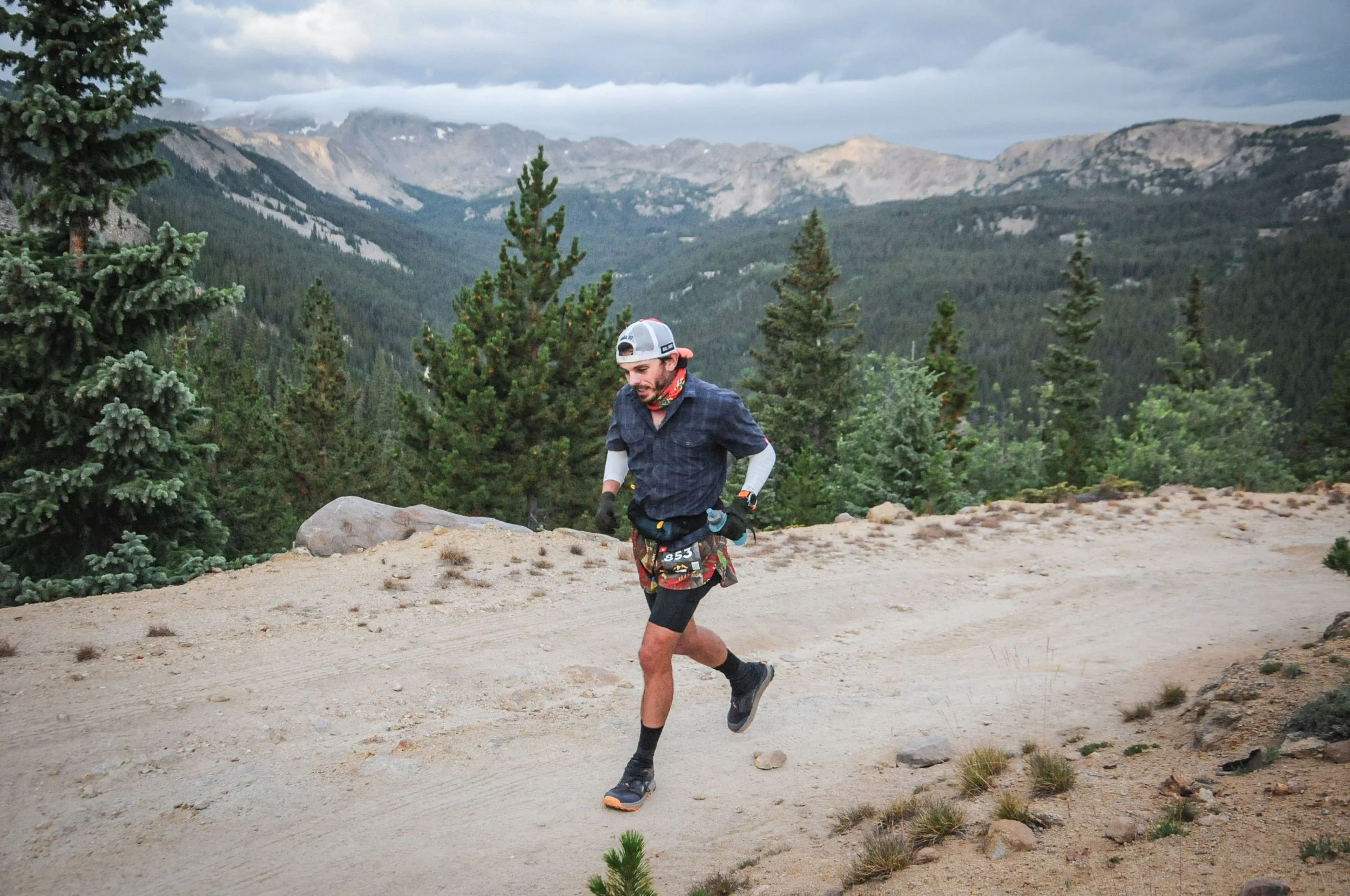
Running up Sugarloaf Pass at the Leadville 100.
In retrospect, I think the bloating feelings I experienced at both WSER and Leadville were caused by how the body metabolizes the simple sugars we use for fueling for ultras. For example, David Roche is the most well known high-carb ultrarunner and he constantly talks about passing gas, burping and pooping on trail in order to keep himself going as a result of his high-carb racing strategy. I know reading this, ultrarunning doesn’t sound like a sexy sport, but many times it isn’t. You learn weird things about your body and physiology from running long distances... I should also note, my fueling plan at both Western States and Leadville were exactly the same. The vast majority of my calories in both races came from maple syrup (which I store in 250mL soft flasks; they equate to about 800kcal/bottle and are much cheaper and tastier than gels in my opinion). I also got a lot of calories from Tailwind. I use the 200kcal/630mg of sodium per packet packets that they sell. I try to consume one of those packets for every 1 liter of water I consume. At Western States, I did this and only experienced GI distress for 3 miles of the 100 mile event, which I think is a high success rate in ultrarunning, so I did this for LT100 too.
Once reaching the summit of Sugarloaf Pass, the LT100 course dips downhill and winds its way towards a concrete road that takes runners to Outward Bound. Many people call this part of the Leadville course, the Powerline section, due to the towering powerline that runs along the entirety of the descent. Parts of the descent are loose and rocky, but it is generally very manageable. My biggest piece of advice to new Leadville 100 runners is to take this section easy. Too many inexperienced people run this section too quickly and trash their quads running downhill too fast. Sure, doing this might get you to mile 40 faster than people like me, but it’s a 100 mile race; not a 40 mile one. You will need your quads to get down Hope Pass two more times if you want to finish this event. Don’t waste them saving 4 minutes on the mile 20 Powerline descent. Said another way, if you can run 14-minute miles from mile 85-100 instead of 20-minute miles, you will finish the race 1-hour and 30-minutes faster than the person who saved 4 minutes trying to look cool at mile 20.
Upon reaching the bottom of the Powerline descent, there was a new “aid station” set up. It was an unofficial one run by Training Peaks and none other than Kevin Goldberg of the Distance to Empty Podcast was leading it. I was featured on his show to discuss nutrition for 200 mile races back in February of this year, which was a great honor, considering the clout of the athletes he has hosted. After passing Kevin’s aid station, I reached the road that led into Outward Bound, the mile 23 aid station. Based on my watch, I was running about 15 minutes slower than I had anticipated at this point, so I decided to run the road miles into the aid station quickly, at a sub-9 minute pace. When I got to the aid station, I was greeted by a large crowd and my trusty friend, Brian Steiner who was filming my entrance. I got there in 3:59, which was frustratingly behind the LT100 24hr pace chart. More importantly than my time though, Brian and I would perform the best aid station transition of my life here.
As I ran into the crowd of spectators at the Outward Bound aid station, my friend Brian put his phone away from filming and began jogging next to me. He was poised after my intense crew meeting to meet my expectations of quick and flawless aid station transitions and was intent on living up to my expectations, which in that moment, he surpassed. While jogging into the aid station next to each other, Brian and I began trading used water bottles for new ones. At one point, I held a used bottle in my mouth that Brian grabbed while we simultaneously traded a flask of empty maple syrup for a full one. By the time we reached the aid station table 30 seconds later, I had traded all the gear I needed to with Brian. At the aid station table, I quickly dropped off my gloves and headlamp before grabbing a handful of chips and then running out of the aid station. The entire transition took less than 1 minute. I was so proud of my friend, but also of my own planning for this event. As both a coach and an athlete, I find it incredibly important to reduce aid station transition time so that moving time can be prioritized. Nobody will run their best 100 mile race if they spend 5 minutes at 20 aid stations (that comes to 1:40 of stoppage time for reference).
I ran out of the Outward Bound aid station with a glowing smile. I had so much pride in my aid station transition, that I filmed a whole video for YouTube, talking about what had just happened while running down the road towards the Half Pipe aid station. For reference, I put together an entire PowerPoint presentation, spent an hour reviewing aid station transitions with my crew, and even put notes in every drop bag telling them what to do. It felt great to see my preparation pay off. Along the concrete road towards Half-Pipe, I also crossed the 25-mile marker in 4:10; the fastest I have ever reached that point in a 100-miler. Although this was very fast, I thought it was appropriate given how the LT100 course is structured. For reference, I ran a 23:17 at Western States and crossed the 25-mile marker in 5:10, 6-weeks prior. But the first 40 miles of the LT100 are incredibly flat and easy compared to other events I have done.
Around the marathon marker, the Leadville course turns onto a 4x4 dirt road that runs south along the Sawatch range and towards Twin Lakes. On many points along this road, such as that first right hand turn, you can see Hope Pass in the distance. Although you know it is only about a half-marathon away, it looks much further, which was disheartening. On the bright side, most of the section is flat with some rollers. It is overall another very fast section of the course. Along it, I experienced the typical highs and lows of a 100 mile race. There were highs, like passing the crewing area which featured funny signs and cheering spectators. There were lows, like finding my friend Joel at mile 35 who was bonking hard. I had expected a top 10 finish from him, but instead, life seemed to have other plans. At one point, a man in jeans passed me on a flat section of trail. I turned to him and jokingly said, “I didn’t have a man in jeans beating me on my bingo card today.” My guess was he was Cam Haynes’ son, who a few friends had told me about. I didn’t know much about him though. I figured he was famous but talked to him like a normal person. We chatted briefly and he told me his name was Truett and that it was his second 100 miler and that his first one took over 30 hours to complete. He joked that he would have to PR today or DNF, which I found funny. He was starting out great and looked poised and strong.
I got to Half Pipe in 4:54. There, the only thing I did was eat some m&m’s and chips. I felt like my bottles were in good shape, and left hastily, but in retrospect, I think I hydrated poorly on the entire section from Outward Bound to Twin Lakes. In that 14 miles, I only consumed 1L of water. I think this happened because mentally, I was underestimating my needs. I had spent so much of the year mentally preparing for the hydration requirements of a 110 degree race at Western States, that I did not take hydrating at Leadville as seriously. Having lived in Colorado for 8 years, I often feel immune to the affects of altitude at this point. Plus, it was a mere 60 degrees and cloudy the day I ran Leadville. My poor hydration did not hurt me in the acute moment, in that I did not bonk or experience GI distress on the way to Twin Lakes, but I do think that, had I adequately hydrated better, I would have experienced less nausea later on in the race. From miles 62-80, I would experience nausea that I do not believe was altitude related as much as it was related to poor hydration. I just wasn’t thirsty. One could say altitude and poor hydration go hand-in-hand, which is true, but there is a nuanced feeling between poor hydration status versus altitude sickness. I have experienced both. Altitude sickness can cause nausea, but that doesn’t mean nausea can’t exist from poor hydration status alone too. Anyways, I point out my flaws as an area of improvement for next time, I suppose. I really did not make any glaringly large mistakes at WSER or LT100 so these small details in retrospect do matter for next time if I’m going to improve, and they matter for you too if you are preparing. For example, don’t only drink when you’re thirsty. Lesson learned (again).
For anyone preparing for LT100, the run from OB to Twin Lakes is largely runnable and features flat and rolling trail. The trail does turn to singletrack for a good 10k into Twin Lakes and has you run along the Colorado Trail again. This section of the CT is very pretty and features some of my favorite aspen trees and colors along the sides of the trail. There are also ample streams along this section to refill water or douse yourself with. My year at Leadville was a temperate year, but many years are hot and dry. Be sure to take advantage of these water sources both for hydration but also to cool off in hot years.
I ran into Twin Lakes in 6:29. For a 24hr pace, LT100 recommends being there in 6:37, which I find odd because I was behind their recommended time at Outward Bound. This is a good reminder that running your own race is often better than following standards set by someone else. We all have our own strengths and weaknesses and should plan a race strategy from our own individuality.
At Twin Lakes, I continued to prioritize aid station efficiency. The Twin Lakes aid station is hectic, and the aid station (with food/water) is set up very close to where the trail pops you into town. I went there first, before finding Brian, and grabbed my usual m&m’s, fruit and chips combo. I stuffed food in my mouth while jogging through the cheering crowds to find Brian, who was ready for another quick and organized transition. With Brian’s help, I switched from a waistbelt (Naked belt) plus a handheld bottle to a running pack (pre-filled with everything I needed). I did keep the waistbelt (because I like how it conveniently stores my maple syrup flask, which doesn’t fit into my pack very well) and also picked up poles. The entire transition only consisted of maybe 30 seconds of time where I was stopped. On the way out of the aid station, I spotted a few acquaintances I had made a month prior while volunteering at the High Lonesome 100. It was exciting to see familiar faces in the large crowd and soak in the energy everyone was giving. The Twin Lakes aid station is one of the most eccentric aid stations in US ultrarunning and one of my goals for LT100 was to be present for those energizing moments. This was so important to me that I told my crew to not speak to me about racing logistics while running through Twin Lakes. Instead, I told them I wanted to be present and discuss logistics when we were stopped. It was the one thing I was willing to trade time for.
By the time I left the Twin Lakes aid station, I was looking forward to my trek up Hope Pass. I had run almost every step of the first 40 miles of this race and the idea of hiking uphill sounded like a nice alternative to break up the pace and work different muscles.
Of course, before beginning the famous Hope Pass climb, is the infamous water crossing that lies about a mile outside of the Twin Lakes aid station. This water crossing is short, and the water only reached my shins. I personally did not find it very difficult. It helps that most LT100’s, the temperature is warm. Even on a cool year like mine though, it is so dry at 10,000+ feet of elevation that your feet/socks/shoes dry quickly during the day after the crossing. I also enjoyed Buff, who was stationed near the water crossing, and playing motivational music for runners. The day before the event they accepted song requests and played mine for me when I passed by, which was the song Puppets by Atmosphere.
P.S. Don’t be the asshole who brings crocs to Leadville for the water crossing. Not only are you a pussy, but it goes against the race rules to leave shoes/nutrition/additional assistance on the course for yourself. And yes, I’m looking at you, “runfluencers.”
After the water crossing, I was excited to finally be racing Hope Pass, admittedly due to some frustrations. You see, being a Colorado resident/ultrarunner for 8 years has given many people I’ve met over the years the opportunity to ask me if I’ve ever run the Leadville 100. They ask me that because it’s one of the few “mainstream” 100 mile races that exist. Many “normal” people or non-ultrarunners know if it because of the book Born to Run or their favorite influencer who’s done it. When I tell them I haven’t run Leadville, but that I’ve done other 100 milers, most people seem to focus on the part where “I haven’t run Leadville.” As a dedicated ultrarunner, I find this rather insulting because other 100 milers I’ve completed like the Bear 100 (which I’ve done twice), the Cascade Crest 100, Silverheels 100 (completed twice) and Moab 240 (completed twice) are harder. I find it frustrating that my other accomplishments are overlooked because, “I haven’t done Leadville yet.” Other people’s opinions don’t affect my self-esteem, but that doesn’t mean those conversations aren’t annoying. Context matters, which is why I bring this up; it was important detail in my race, because some of that frustration pent up over the years and ultimately led to me expending too much energy on my first trek up Hope Pass. On one hand, I passed a lot of people going up Hope Pass that first time. The only person who passed me was Truett Hanes (props to him; it made me not mind losing to a man in jeans). I moved quick, strong and efficiently. I enjoyed straining myself as I generally do when climbing mountains. But in retrospect, I did go too fast and would struggle up Hope Pass my second time because of this. In other words, I let my ego get the best of me.
I reached the top of Hope Pass in 8:25. During a training run a few weeks prior, my watch clocked 3,200ft of gain to get there from Twin Lakes. Before getting there, I began calculating David Roche’s eta to his second Hope Pass summit and wondered if he would reach it a second time before I would my first time. This motivated me to push the last little section up. Luckily, I did make it to the summit before him, but just barely. When I reached the summit, I tried my best to soak in the view of Mt. Huron in the distance along with many of the other Sawatch peaks. I took a quick video, but knew my opportunities to race Leadville were much fewer than my opportunities to enjoy the view on Hope Pass. Besides, I had already been on top of Hope Pass for a training run a few weeks prior and ate lunch on top of the pass while hiking the CT in 2022. It was also lightly hailing on top of the pass; a sign that I shouldn’t stay for too long. Just as I began descending; maybe on my third switchback, I saw David Roche running his way up. He ran every single step and still had the energy to muster up a slurred “you’re amazing” as he passed by me. It was as incredible to see as it was demoralizing. Even with all the scientific training I do, I don’t know how he does it. Life isn’t fair, I guess.
The first two miles down the south side of Hope Pass are fairly steep. Everyone talks about the way up, but athletes also need to be prepared for the way down, which works your muscles hard. If you are training for the LT100 (especially if you live somewhere flat), make sure to include eccentric exercises like lunges, squats, box jumps, heel to floor lowers for your shins, calf lowers, etc. You need to be able to withstand 5,000ft of steep descending in a relatively short time. On top of the descent being steep, it is rocky and technical in many sections too.
After about 2.5 miles of steep descent from the top of Hope Pass, the trail reaches a junction where you take a sharp right and stay on the Colorado Trail. This is an important mile marker/junction, because although the steep section is over, you still have 4 miles to get to the Winfield aid station from here. On paper, this 4 miles looks easy, since you’ve already summitted Hope Pass. When you reach this section of the trail though, it is rolling and trends slightly uphill for much of this 4 miles. It is more mentally difficult than physically difficult because the gradient when the trail rolls is not steep, but it is consistent. This makes running rather difficult. When I was running this section during the race, it also got quite hot out. Luckily, there are a few streams you can use to cool off at which is helpful.
I got to the halfway point of the race, Winfield in 9:50, which was about 5 minutes slower than my predicted time. I thought this was solid, and I felt as good as one can feel at mile 50. The aid station is set up at the end of what is basically a large football field sized campground. While there, I stuffed ice in my hat, arm sleeves and bandana. I also drank coke and ate what felt like a lot of ramen and chips. I thought I took in maybe 400-500kcal there.
When I left this aid station, I carried my typical nutrition plan (maple syrup + Tailwind). I also carried two 500mL flasks with a third bottle to fill at a stream (if I desired to). For reference, many people can do the section from Winfield to the Hope Pass aid station (~6 miles) without more than two 500ml bottles, but many will require more than that on a hot day (or if you are not adapted to altitude). If you fall in the latter category, you have a few options. One is to fill three bottles at the Winfield aid station. Another is to replenish water by quickly topping off your bottles with unfiltered water at one of the multiple streams along the way up Hope Pass. The last option is for people who do not like drinking unfiltered water; in this case, bring a filter for your bottles and then you can drink stream water with more guaranteed safety. In my personal opinion/experience, water in the Sawatch range is generally safe to drink unfiltered; especially the higher up you go on the pass. I probably underhydrated on this section and only drank two bottles of water for reference.
Another good tip for people is to run the 4 miles from Winfield to the junction that begins the very steep climb up Hope Pass for your second summit as strong as you possibly can. These miles are rolling and mostly flat/downhill. Take advantage of them before you lose time on the steepest/slowest miles of your race, which will surely be when you climb Hope Pass for your second time.
I ran the miles from Winfield to the junction up Hope Pass at about 12-14min pace, which I thought was pretty good while I tried to get back into a rhythm running out of the halfway mark. On the way out, someone passed me and yelled “It’s Stefan of the Journey Running Podcast!” which I thought was pretty cool. I didn’t get a glimpse of who that person was, but I appreciated the comment. My podcast is small, so it’s cool to hear someone is listening. Also, during that section, the ice in my bandana, buff and arm sleeves melted but the temperatures began to cool down again with increased cloud cover. I wondered if I would make it over Hope Pass again before a typical Colorado afternoon monsoon would roll in, especially since it was lightly hailing on my first summit.
When I reached the junction marking a steep 2.5 miles to the summit, I still felt good. I was intent on hiking the two miles just as strong as I did my first ascent up Hope Pass. Shortly into my way up, a familiar face yelled “there’s that great smile!” I looked up to see Andy Glaze who was beaming as usual and laughed. “Shouldn’t I be the one saying that to you?” I remarked. After all, Andy is the “smile or you’re doing it wrong” guy. I think it’s so cool he takes the time to interact with random fans like me.
Despite my desire to push to the top of Hope Pass, I really struggled in that last 1.5 miles to the summit. As my energy levels sank, I pressed myself for reasons why. I felt like I was bonking, but statistically speaking, my fueling plan was going very well, as I continued to consume 200-300 kcal/hr. I actually think I consumed more than this per hour on the Hope Pass section, but maybe my estimates were wrong. My hydration status was reasonable. Inadequate might be a fair word to describe it, but not terrible. Also, my left knee was starting to bother me. It felt like tendinitis, which I sometimes experience during races. Because it was a familiar feeling, it was annoying but not alarming. What was surprising about it though, was that my knee was bothering me on an uphill hiking section of the race. Usually, tendinitis is bothersome on downhill or very runnable sections. Ultimately, poor energy levels and some knee pain made for a slower ascent than I was aiming for. My miles were 23-26 minutes each, which is still not bad considering the grade of Hope Pass and that I was now at mile 55-57ish.
When I reached the summit of Hope Pass, it was once again lightly hailing. I decided to skedaddle down as quickly as possible to get some fuel at the aid station. My second summit was not as sexy as I wanted it to be, but it was still good. Often times, that’s all we need from ourselves in tough events. You can’t win a 100 miler in one mile, but you can lose it in one. As long as you perform decently as opposed to terribly in your bad miles, you can do great (assuming most of your miles are good ones).
The descent to the Hope Pass aid station from the summit went by quickly. At this point, I was now passing runners who were still ascending Hope Pass for their first time. They would likely not make the Winfield cutoff, which was a disheartening thought. Many hopes and dreams die on Hope Pass, which is sad but adds to the allure of completing a difficult race like Leadville.
When I reached the aid station, I performed my usual ritual of eating m&m’s, chips and refilling my bottles. In retrospect, I should’ve had more food there. Instead, I spent a minute taking a selfie with a llama that hauled gear up the pass. The time burned to get the photo was worth the memory though.
When I left the aid station, I was excited to know my next stop was Twin Lakes, where I would pick up my first pacer. I knew it was just a few short miles and the thought of descending into Twin Lakes sounded better than the descent into Winfield. This is because it’s all downhill and then totally flat into Twin Lakes the second time. No annoying 4 miles of rolling hills on the trail into Twin like there is into Winfield. However, my left knee had other plans than what my expectations were and again started bothering me on and off during the descent. I moved down the pass quickly but by the time I reached the bottom, my left knee was in a fair amount of pain. I ended up doing a combination of running and walking into Twin Lakes because of this, which was frustrating. During ultras, it is common for short-term aches and pains to bother us, and my hope was this knee pain would be temporary, but it would continue to sporadically bother me for the remainder of the race.
Side note: now that a few months have passed, I can retrospectively pinpoint the cause of this problem. The week after LT100, I had some left hip pain that resolved after a week. The next month, I had some left foot plantar fasciitis. Then, two months later in October, I experienced knee pain related to my IT band (also on the left side). This knee pain persisted for about a full month (the longest I’ve had an injury for in years). The injury resolved after I saw my PT who told me my left quad was tighter than my right, which was causing a pulling on the left outer part of my knee. As I write this, the issue is now resolved, but I didn’t realize I had this imbalance before/during Leadville. It makes a lot of sense now, that my pain during the race would resolve (temporarily) when my pacers would roll out my IT band with my poles every so often.
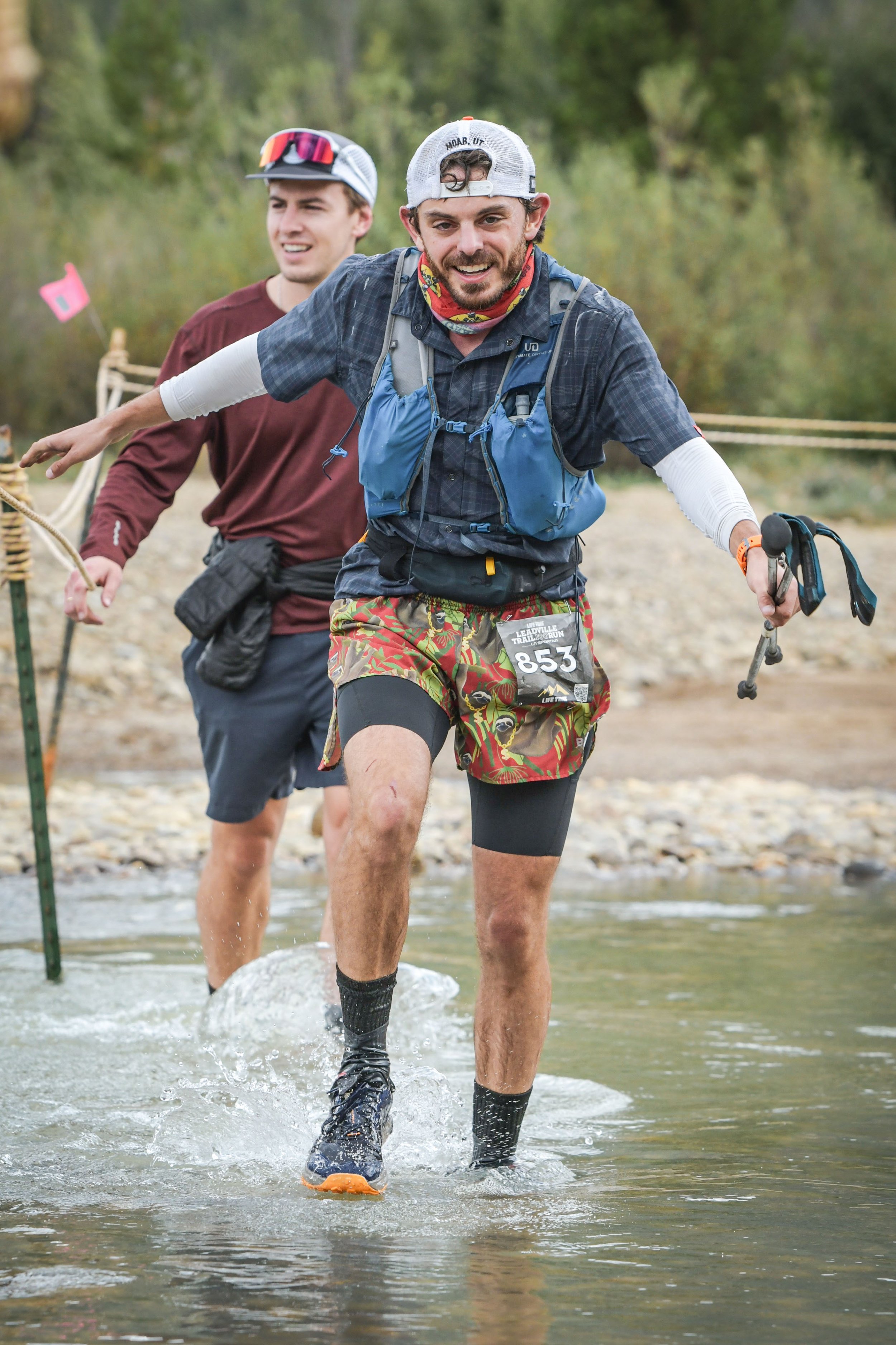
Crossing the river my second time, on my way to Twin Lakes.
When I finally reached the Twin Lakes aid station again, it was a bit awkward of an experience, On one hand, I was excited to run through the aid station and soak in the crowd’s energy again. On the other, I was running through it pretending like nothing was bothering me. Also, while running through the aid station with my friend/roommate/pacer, Dave Braunlich, a guy in a sumo wrestling costume ran through the whole aid station with me. I appreciated the man’s energy but thought it was rude that he wouldn’t stop talking to me when multiple friends were trying to get my attention too. There was a lot going on; this random guy in a sumo suit trying to motivate me, the crowds in the distance, friends trying to say hello, all while the condition of my knee was on my mind. It was a little overwhelming.
It was relieving when I finally reached my crew and was able to take a seat. Brian had luckily met a guy who was a PT who offered to massage my knee while I ate food, swapped dry bottles with new ones and changed shoes. Up until this point, all of my aid station transitions were quick and flawless, but because of my knee, this stop was longer than I’d hoped for.
The run from Twin to OB again was frustrating. Although the first two miles are uphill towards the Colorado Trail, about 12 of the 15 miles that compose the section are flat/downhill. Maybe 1-2 of the miles in the section on the CT are rolly. Despite my intermittent knee pain, I ran a lot and somehow kept moving up in the competition of the race. To alleviate knee pain, my pacer Dave offered to use my poles as a foam roller on my thigh/IT band area. It surprisingly worked, but I was only able to run about a mile in between stopping to let my pacer do this. It was very frustrating, and my average pace slowed to 15 minute miles on what should’ve been a faster part of the course. Sure, some of the miles were faster in the 11-13 minute range, but some with more uphill were slower in the 15-17 minute range. On top of my knee struggles, I also started feeling dizzy around the half pipe aid station. I don’t think I hydrated very well during many parts of the race and it started catching up with me here. Like, I remember walking up to the aid station table and completely having the spins. The problem was, I was still doing so well time-wise, that I didn’t want to sacrifice more to sit aka “waste time” to potentially solve the problem. I get nausea fairly frequently during 100 milers anyway. I don’t think it was altitude sickness.
As Dave and I ran out of Half Pipe, we wondered if we would be able to make it to Outward Bound before dark. It was unlikely and would be close if we did. By the time we reached the concrete road with we made it about a mile before doing the last two with a headlamp on.
When I reached Outward Bound in 16:46, my crew informed me that I was apparently fighting for a spot in the top-20. I didn’t believe them. I felt like shit and honestly thought they were trying to be creative to motivate me. For context, it is important to note Outward Bound is a tough aid station for athletes because the area is very cold. It’s located near a stream and when I got there and stopped moving, I immediately started shivering, which is a normal response for ultrarunners. For most a race, your body is trying to cool you down, so when it finally needs to warm you, that can often lead to intense shivering. Although it’s a normal physiological response, it’s not fun to experience. I was also slightly nauseous and my knee was still bothering me intermittently. On the flip side, this aid station is great because they have a lot of resources (food, crewing area, tents to sit down at, etc.). If you are running this race, I recommend an extra layer while you are stopped at this aid station. The cold lasts from OB for about a mile or two up the road before warming up again, so you won’t be cold for long, but you don’t want to lose too much body heat/energy because you’re too lazy to spend 30 seconds putting on a jacket.
At Outward Bound, I threw on a layer (light rain jacket), gloves, ate a few cups of ramen, coke and picked up my waistbelt/Ultraspire light. Leaving the aid station sucked. It was another semi-long stop for me (maybe 10 minutes), which I hate doing at races. It was freezing cold and a wave of chills overcame me when I stood up to begin moving again. It took a lot of mental fortitude to muster up the energy to start running again, but after waddling out of the aid station, I started running when I hit the concrete road, this time with pacer Brian Steiner by my side. Brian has paced me at three other 100+ milers and is a 3x Leadman finisher, so I trusted him to take me to the finish line. He also deserved the honor of completing the last 22 miles of the race with me because he drove all the way to Leadville from Oklahoma City to crew and pace me. He did a great job staying organized and following my directions to make aid station transitions quick and efficient, which I very much appreciated. Everyone needs a friend like Brian in their life.
The first few miles running towards the Powerline climb were easy on the concrete roads. Brian and I moved well for these miles, and my knee pain was surprisingly starting to dissipate which was a relief. I also appreciated this from a statistical perspective because I knew the powerline climb was going to slow my average pace to the finish line.
After a few miles moving well on the concrete road, it was time to take the dreaded left turn by LT100 participants onto the dirt road that leads towards the final difficult climb of the race. Upon hitting the dirt road, I did my best to run what would be the last runnable feet before about 3 miles of hiking uphill. When I reached the bottom of the climb, a friendly face awaited me. It was Kevin again who told me I was crushing it. I was probably in about 20-25th place and pushing hard to be in the top 20. I thought the last sections of the race catered to my strengths, but it was time to put that hypothesis to the test.
The beginning of the Powerline climb is the steepest. Still, Brian and I maintained 20-21min pace uphill. I didn’t feel like it was my best, given how much time I spend running and hiking up mountains in my free time in Colorado, but it was good, considering we were at mile 81. Luckily, my knee wasn’t bothering me much on this section which helped too.
In between bouts of climbing up powerline, there were short but runnable flat/downhill segments where Brian encouraged me to run. I tried my best to listen to him, and was able to muster up the energy to do so.
At night, the powerline climb feels like a big maze. It feels like every corner you turn, you flash your headlamp up the mountain, expecting to find some reprieve in how much you’ve climbed, but there is always more. Brian and I conversed about the first time we both completed this climb. It was together in 2019, when Brian was fighting cutoffs for what would be his first Leadville 100 finish. He finished in 29:45 that year, when the race has a 30-hour cutoff. When Brian and I did that climb together, there were many people around us, in the back of the pack as they say. What I liked about climbing powerline with Brian in2 019, was that when you looked down the mountain, you could see hundreds of headlamps, mostly in pairs; runners with their pacers, slowly hiking uphill. That moment has always left an imprint on me. The view of hundreds of people fighting in the middle of the night on a random mountain pass to achieve their dreams of finishing the Leadville 100 was inspiring. I remember seeing the lights, seeing Brian fighting his way up the climb, the cold, the shitty gear I wore 6 years ago, hearing someone blow a vuvuzela (which has always annoyed Brian, but I found it inspiring). It was fun reminiscing on that memory with Brian. He still says that he hates the sound of a vuvuzela and I still laugh when it’s brought up. This time, we were essentially alone though, on track for a sub-24 hour finish. Despite my strong pace, we were passed by a few runners on this section which was frustrating. Other than seeing 2-3 people, we were all alone. It was a very different experience than my first time on this climb.
When Brian and I finally did crest the final climb of powerline, we were greeted by the infamous Space Camp. Space Camp is an unofficial aid station at the Leadville 100, which is run by Floyd’s of Leadville (a CBD shop in town). This aid station is most traditional of ultrarunning at the LT100. On top of the pass, they serve shots of whiskey, pass around half-smoked bowls of marijuana and probably have stronger substances for those interested too. They also put on a hell of a party with their bright lights and music.
When Brian and I arrived at this most eccentric aid station, Brian snapped a quick photo of me under the banner that reads: “Welcome to Space Camp... Nice Fuckin’ Work!” Unfortunately, I was in no mood to celebrate our arrival. In previous years, Brian had joked that an LT100 finish doesn’t count unless it’s accompanied by a shot at Space Camp. By this point at mile 84, I was in no mood to joke though. Despite my best attempts to fuel and hydrate adequately, I was exhausted and marched through Space Camp like. I grabbed a few chips, some coke and continued on, simply not caring for the party atmosphere. Brian, on the other hand, reminisced of old times and took a shot with another pacer at the aid station. I was happy he could celebrate, and wished I felt as lively as he did. I can now attest that pacing this section of Leadville is much more fun than racing it.
The whole climb up powerline, my goal was to hike uphill fast enough to put myself in a position to finish the race strong. I knew every mile after the summit was mostly downhill, rolling and generally flat. Life had other plans though and my race took a turn at mile 85. I didn’t run much of the race after this point, which was disappointing. After passing by Space Camp, I generated the strength to run small segments of the descent down Sugarloaf Pass, but I could not run more than a few feet without my legs giving out. It was an odd sensation, because anyone reading this will likely think, “What do you expect at mile 85 Stefan?” But this was my 14th time being at mile 85 of a 100 miler, and it felt like I was suffering the most of all my finishes. Usually at mile 85, I still have the strength to run flats and downhills, but this time I didn’t. My thoughts raced, as I could feel my race taking a turn for the worst. I knew, if I hiked the last 15 miles of the race, I wouldn’t finish for another 5 hours, when I was hoping to be done in 3.
I searched my mind, trying to understand, Why now, why this time, do I feel this exhausted at mile 85? What is different this time, as opposed to my other 100 mile finishes? My first thought was that maybe I started the race too fast, but I didn’t think that was the case. I was chatting with other runners for most of the first 12 miles. I also conserved energy on the powerline descent. I then wondered if my fueling plan was inadequate, but it worked for me at Western States; why wouldn’t it work now? I then thought about how I lived my life over the previous 6 weeks before LT100. In the 6 weeks prior to running Leadville, I had finished the Western States 100, then proceeded to pace/crew the Badwater 135 and then volunteered overnight at 12,000 feet at the High Lonesome 100. These three sleepless events occurred for 3 consecutive weeks in a row, which likely left me in a state of sleep deprivation at the time. Still, after this, I proceeded to complete two difficult weeks of training for LT100 and finally moved apartments 2 weeks prior to the race. This, I thought, was the best explanation for how I felt. I realized I had tired myself out both mentally and physically before the race ever even started. It was actually amazing I did so well for the first 85 miles. Still, I tried to stir up the energy to run those last 15 miles, but my efforts felt futile. I told myself my current reality was a punishment for how I lived my life over the summer. Even in the moment, I regretted nothing, but I began to cry as Brian and I poorly hiked our way down Sugarloaf Pass. I am not sure how many rocks I kicked on the way down, which did not help either.
Despite how I was feeling, Brian and I arrived at Mayqueen in 20:19. On first glance, a sub-24 hour finish sounded like it was in the bag with 3:40 to spare, but I was feeling terrible. It was freezing cold at Mayqueen and taking a moment to sit down did not help. There, I had to force down two cups shitty ramen that tasted like it was sitting in lukewarm water and didn’t contain enough electrolytes plus some coke. I typically am excited to be at this point in a race, but this time I wanted to be done. There were many places that sounded better to be than where I currently was.
In order to regain body heat, Brian and I ran out of the aid station. We made it a good half-mile which was some of the last running I did of the race. I was moving so poorly that when we reached the singletrack that rounds Turquoise Lake, I told Brian that I wanted to set the pace. But after a mere 30-seconds of letting me lead, Brian told me he would in fact be setting the pace. He said we weren’t moving fast enough to go sub-24, which was frustrating. But I listened to him.
The miles I did with Brian around Turquoise Lake were some of the hardest of my ultrarunning career. Both on paper and in-person, these miles are not particularly difficult. The singletrack trail around the lake rolls but contains no significant climbing and is not technical either. At mile 88 though, it felt like the race organizers had paid construction workers to dump rocks onto the course. It was so much harder to run the second time. Likely, because my brain was tired of deciding where I should place my feet. Overall, I felt like I was being punished on this section, not only for how I lived my life over the summer, but for how hard I had paced Brian at Leadville in the past (and another athlete I coached for LT100 and who I paced for this section too).
My ailments rounding the lake were plentiful. My legs were exhausted, it felt like no mount of nutrition or caloric intake was giving me life, my left knee was again intermittently bothering me, and I also started to experience breathing issues (which was dust-related, not altitude). It felt really hard both during and after the race to take a full inhale. This happens occasionally in trail running, when events take place on very dusty trails. An inhaler can help, but I did not have one with me (I also don’t own one).
My memory of rounding the lake with Brian was him slowly running/walking ahead of me setting the pace, which ended up being about 17-minute pace. Every so often, I would find the courage to run a few feet but mostly, I was hiking at my maximum capacity. I was so tired, I checked my watch every 0.05 miles to check the progress/pace which was likely an unhealthy strategy to monitor my progress. All of my efforts were focused on taking the next footstep forward. Although the immediate moment sucked, I knew that it would eventually be over. Brian kept telling me that “I would hate him now and thank him forever after we go sub-24.” I knew he was right, but that didn’t make it any easier in the acute moment to enjoy myself.
When Brian and I finally finished rounding the lake, we crossed a road and slowly descended a steep embankment which took us to a flat road. Brian kept bothering me to run, and he was right to do so. After a flat two miles, the race ends with an annoying uphill gradient that runners know so well. The type of gradient you don’t want to run, but that is not steep enough to want to hike either. This goes on for 3 miles. Before hitting this climb, Brian pushed me to run and I did so for a bout 0.2 miles at a time, with short walking breaks in between. At this point, my breathing issues were worsening, and it was getting colder outside. I wore a t-shirt and rain jacket, but no more. I did not want to stop to put on another layer at this point though. Onward felt like the best option. I did not work as hard as I did to miss a sub-24 hour time because I wanted an extra layer on “for convenience.”
After hitting the final 3 mile climb, I basically powerhiked into the finish line. I tried running it in with a quarter mile to go, but my knee hurt badly. To mediate the pain, I waited until I was at the red carpet to run my final steps of the race and finished in a time of 23:45. It wasn’t pretty, but I qualified for the big buckle and achieved my B-goal of running sub-24 at Leadville. Somewhere in me, I know is a 20-22 hour finish at this race. This was very frustrating and on my mind at the finish line. But, I knew I did the very best I could given how I felt on that particular day. For that, I was proud. There will be a next time, and next time, I will train more effectively in the 6-weeks leading up to the race if I really want to accomplish my time goals at Leadville.
Waiting for me at the finish line was my friends Dave and Jamie. I made sure to get a photo with the crew and thanked them for being there for me.
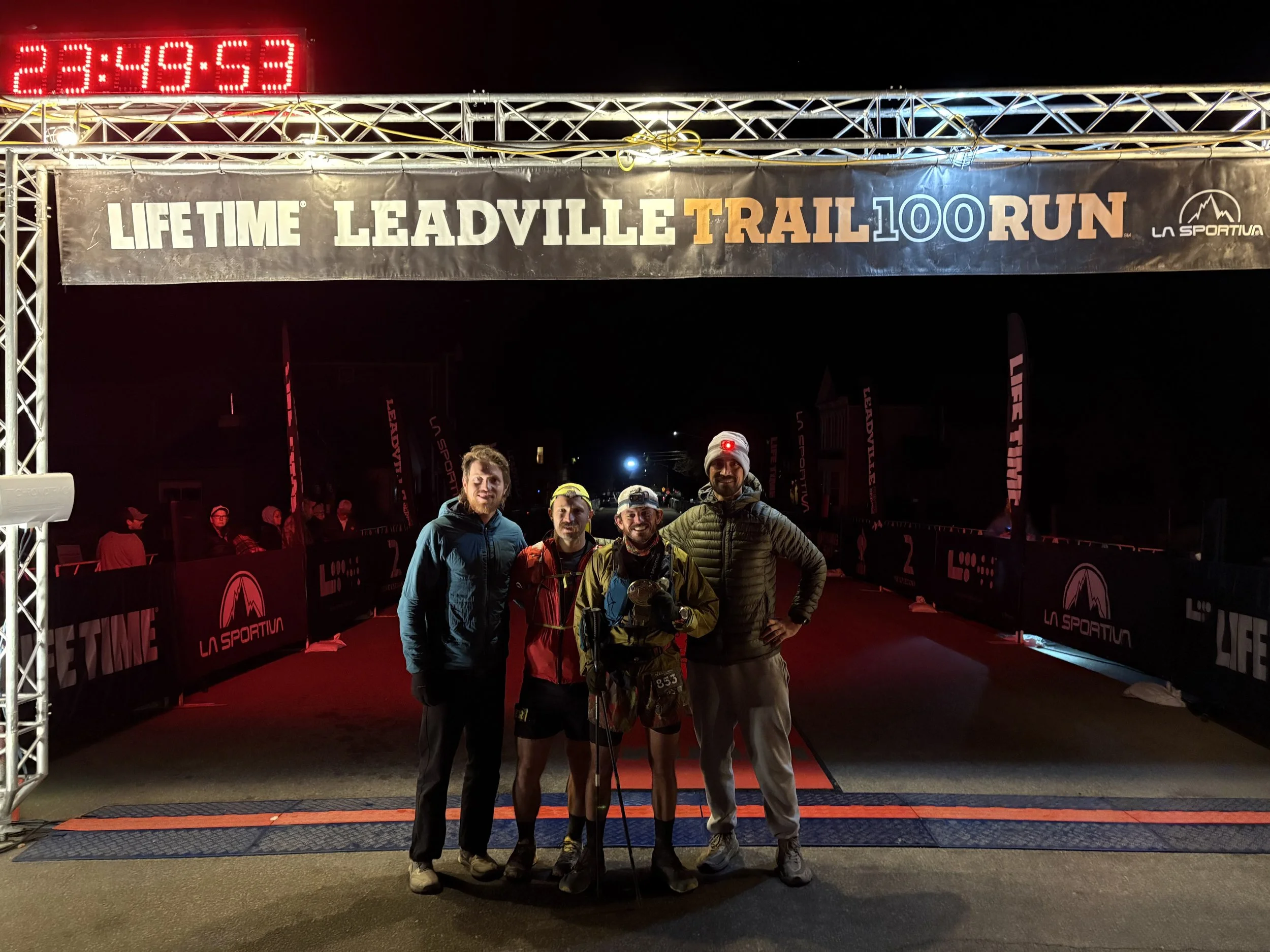
Finish Line of the Leadville 100. Left to Right: Jamie, Brian, Myself and Dave.
A few post-race takeaways:
1) Don’t run a 100 miler, crew Badwater for two days, volunteer at a race, and move apartments while training in the 6 weeks leading up to a 100 miler.
2) I fueled for Western States and Leadville largely with maple syrup and Tailwind; both great sources of simple sugars. Towards the end of both 100’s I felt fatigued and like the calories were not providing me enough energy; mostly this was an issue at Leadville. In the future, I will look for starchier and slower burning fuel sources to incorporate at the end of 100’s. It is one thing for elite athletes to run on a high-carb diet for 14-16 hours. It is another for non-elite athletes like me who are finishing in 20+ hours to fuel high-carb for that long. I need a better fueling plan for miles 80-100 in the future.
3) I need to improve at hydrating in cool conditions. I hydrated very well at Western States because of how nervous I was for the heat. Being that Leadville is in my backyard, I wasn’t nervous for the race or altitude. This backfired on me which resulted in poorer hydration status during the race than WSER despite the much cooler temperatures.
4) A wholistic takeaway is that I wouldn’t have run sub-24 without Brian being assertive as a friend and pacer. There is a time and place for that behavior from a friend, when to do it and when to accept it as the athlete. Brian isn’t a guy who takes bullshit and he was a good person to have on the last section. In the moment, he told me I’d hate him during the race and love him later. I appreciated his wisdom and firm decision making.